
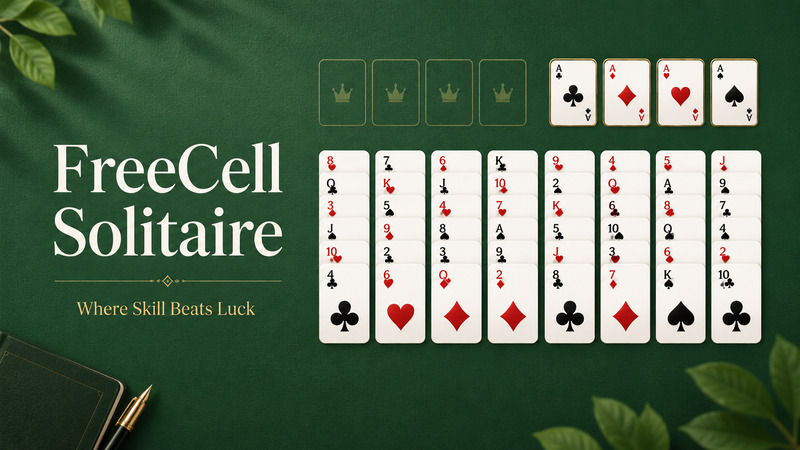

Most card games begin with uncertainty. You receive a shuffled deck, make the best moves you can, and hope the cards work in your favor.
FreeCell Solitaire is different.
All 52 cards are visible from the first move. There is no hidden stockpile, no surprise card waiting to appear, and very little room to blame a bad result on luck. In most games, a winning path is already somewhere on the board. Your job is to find it.
That is why FreeCell is often seen as the thinking player’s version of solitaire. It may look simple, but every move changes what you will be able to do later.
Here is how FreeCell works, why nearly every deal can be won, and which strategies will help you solve more games.
Why FreeCell Feels Different From Other Solitaire Games
In Klondike Solitaire, many cards begin face down. You cannot fully plan because you do not know what is hidden underneath them. Even careful play may fail if the cards you need are buried in the wrong places.
FreeCell removes most of that uncertainty.
The entire deck is dealt face-up into eight columns. You also receive four free cells for temporarily holding cards and four foundation piles, where each suit must be built from Ace to King.
Because every card is visible, FreeCell becomes a puzzle rather than a guessing game.
You can identify:
- Where each Ace is located
- Which cards are blocking important sequences
- Which column may be easiest to clear
- Which moves will open or restrict the board
- Whether a plan will work before you begin moving cards
The challenge is not discovering hidden information. It is choosing the correct order of moves.
Can Every FreeCell Game Be Won?
Not every possible FreeCell deal is solvable, but almost all of them are.
The original Microsoft FreeCell game contained 32,000 numbered deals. Of those deals, only game number 11,982 is considered unsolvable. Later Windows versions expanded the collection to one million numbered deals, with only eight generally recognized as unsolvable. That gives the well-known Windows deal set a theoretical win rate of at least 99.9992%.
This does not mean every deal is easy. Some games require long move sequences, temporary sacrifices, and several attempts before the solution becomes clear.
However, it changes the way you should view a loss.
When a FreeCell game becomes stuck, the deal was probably not impossible. More often, an earlier move reduced your available space, trapped an important card, or placed a sequence in the wrong column.
That makes replaying a lost deal especially useful.
The Basic Goal of FreeCell
Your objective in FreeCell is to transfer every card from the tableau to the four foundation piles. To win, all 52 cards must be placed onto the foundations.
Each foundation represents one suit and must be built in ascending order:
Ace, 2, 3, 4, and so on until King.
Cards in the main columns are normally arranged in descending order while alternating colors. For example, a red 8 can be placed on a black 9.
Only exposed cards can be moved. The four free cells can each hold one card, while empty columns can hold a single card or a movable sequence, depending on the rules used by the version you are playing.
These rules are easy to learn. The deeper strategy comes from managing space.
The Most Important FreeCell Strategies
Winning at FreeCell is less about finding clever tricks and more about making consistently good decisions. The strategies below will help you avoid common mistakes and win more games with confidence.
1. Study the Board Before Making Your First Move
The first legal move is not always the best move.
Before touching a card, scan the complete board and find:
- All four Aces
- The 2s and 3s that will follow them
- Cards blocking those low-value cards
- Columns that may be cleared quickly
- Long alternating-color sequences that can be joined
Try to form a short plan before moving anything. Even planning three or four moves ahead can prevent an early mistake.
A useful question is:
What will this move allow me to do next?
A move that creates no useful follow-up may not be worth making.
2. Treat Free Cells as Temporary Tools
The free cells are not permanent storage spaces. They are working in a space.
Every empty free cell increases the number of cards you can rearrange. Filling all four cells may feel productive, but it often leaves you unable to move the cards that matter.
A good habit is to use a free cell only when you know how the card will leave it.
Before placing a card there, ask:
- Where will this card go next?
- How many moves will it remain here?
- Will I need this free cell for a more important card?
Experienced players regularly place cards in free cells, but they also work to empty those cells as quickly as possible.
3. Value Empty Columns More Than Empty Free Cells
Clearing a full column is one of the strongest moves in FreeCell.
An empty free cell holds one card. An empty column can hold a card, support a sequence, or act as extra working space while you reorganize several other columns.
Basic FreeCell strategy guides, therefore, treat an empty column as more valuable than a single free cell.
Once you create an empty column, do not fill it without a reason. Use it to:
- Move a long sequence
- Expose a deeply buried card
- Separate a badly arranged stack
- Build a cleaner descending sequence
- Create another empty column
An empty column often turns a blocked board into a flexible one.
4. Expose Aces and Low Cards Early
You cannot build a foundation until its Ace is available.
If an Ace is buried under several cards, identify a safe route to reach it. After moving the Ace, try to uncover the matching 2 and 3.
Low cards can create traffic jams when they remain buried for too long. For example, a high card may look useful in a tableau sequence, but moving it could be pointless if the low cards needed for the foundations remain trapped underneath other stacks.
Opening the foundations early reduces clutter and creates more movement options.
5. Do Not Send Every Card to the Foundations Immediately
Moving a card to a foundation is often helpful, but automatic foundation moves are not always harmless.
Sometimes a low card is still useful in the tableau. You may need it to hold an opposite-colored card or complete a sequence that helps expose another part of the board.
For example, moving a red 5 to its foundation could prevent you from temporarily placing a black 4 on it.
Before moving a card upward, check whether it still has a useful role in the main columns. Foundation moves are safest when the lower cards of both opposite colors have also advanced.
6. Build Clean, Movable Sequences
The most useful tableau sequences descend while alternating colors:
- Black 10
- Red 9
- Black 8
- Red 7
These sequences are valuable because they can eventually be moved as a group when enough free cells and columns are available.
Avoid creating messy stacks that block useful cards without producing a movable sequence. Whenever possible, combine smaller runs into longer, organized ones.
Think of every clean sequence as a package. The easier it is to move that package, the more control you have over the board.
7. Avoid Burying Important Cards Under Kings
Kings are powerful but difficult to move once placed badly.
A King cannot be placed on another card, so a poorly positioned King may occupy valuable space for much of the game. Before moving one into an empty column, inspect the cards underneath it and the sequence you plan to build.
Do not use an empty column for a King simply because the move is legal. Use it because the King helps you uncover cards, organize a full sequence, or create another clear column.
A Simple Opening Routine for Every Deal
Beginners often improve faster when they use the same opening checklist for every game.
Step 1: Find the Aces
Locate every Ace and count how many cards are covering each one.
Step 2: Find Easy Foundation Moves
Check whether any Aces, 2s, or 3s can be moved without using too much working space.
Step 3: Look for a Column You Can Clear
A short column or one containing several immediately playable cards may be your best target.
Step 4: Identify Natural Sequences
Look for cards that already connect in descending, alternating-color order.
Step 5: Protect Your Space
Try to keep at least one free cell open while improving the board.
This routine takes only a few seconds and reduces impulsive moves.
Common FreeCell Mistakes That Ruin Winnable Games
Even experienced players lose FreeCell games that are technically solvable because of a few avoidable mistakes. Many of these errors don’t cause immediate problems, making them difficult to recognize until the board becomes locked.
- Filling Every Free Cell Too Soon: When all four free cells are occupied, even a simple move may become impossible. Keep some space available whenever you can.
- Moving Cards Without a Follow-Up Plan: A move should expose a card, extend a sequence, clear space, or support another useful move. Moving cards merely because they can be moved often creates problems.
- Using an Empty Column as Permanent Storage: Empty columns are strategic assets. Filling one with an isolated card may remove the flexibility you worked hard to create.
- Sending Cards to the Foundation Too Aggressively: A foundation move can remove a card that was still needed to organize the tableau.
- Ignoring Cards Buried Near the Bottom: A board may look healthy while a critical Ace, 2, or King remains trapped. Always pay attention to the deeper structure of each column.
- Building Only One Long Sequence: A long sequence can be useful, but it may also become difficult to move. Keep enough open space to separate or reposition it later.
What to Do When You Get Stuck
Do not immediately start a new deal.
First, undo several moves and look for the moment when the board became less flexible. Pay attention to:
- The first time all free cells became occupied
- The moment an empty column was filled
- A card sent to the foundation too early
- A King placed in an unhelpful column
- A sequence built in the wrong color order
Many FreeCell apps offer unlimited undo or allow you to restart the same numbered deal. Use these features as learning tools rather than viewing them as cheating.
Replaying a difficult board teaches more than repeatedly starting easier deals.
Is FreeCell Mainly Skill or Luck?
The initial shuffle still matters because some layouts are much harder than others. A difficult deal may require a precise solution, while an easy one may offer several winning paths.
However, the visibility of every card and the extremely high percentage of solvable deals make player decisions the main factor in most games.
That is the special appeal of FreeCell. Your win rate can improve through practice because useful skills carry over from one deal to the next:
- Planning ahead
- Managing limited space
- Recognizing card sequences
- Delaying risky moves
- Reviewing mistakes
- Comparing possible solutions
You are not simply waiting for a favorable shuffle. You are learning how to use the board more efficiently.
Frequently Asked Questions
Is FreeCell harder than regular Solitaire?
FreeCell may feel harder at first because it gives the player more choices. However, it is also fairer than many traditional solitaire games because all cards are visible and nearly every deal has a solution.
Should I always move Aces to the foundation?
Usually, yes. Aces cannot help but build descending tableau sequences, so moving them is normally safe. Later foundation cards may require more thought because they can still be useful in the tableau.
Is an empty column better than an empty free cell?
In most situations, yes. A free cell holds one card, while an empty column can help reorganize multiple cards or move complete sequences.
Can I place any card in an empty column?
In standard FreeCell, any exposed card may be moved into an empty column. A properly arranged sequence may also be moved there when enough temporary space is available.
Does using Undo reduce the value of a win?
That depends on your goal. For competitive statistics, you may prefer to avoid undoing moves. For learning, Undo is one of the best ways to understand exactly where a strategy failed.
Dernières pensées
FreeCell Solitaire looks like a simple card game, but its design gives it unusual depth.
All the information is visible. Almost every deal can be solved. Winning depends on how carefully you manage free cells, empty columns, foundations, and card sequences.
The most important lesson is simple: do not confuse a legal move with a useful move.
Pause before acting. Protect your open space. Uncover low cards early, and treat every loss as a puzzle that may still have a better solution.
The next time a FreeCell deal appears impossible, restart it and try a different route. In almost every case, the winning path is already sitting in front of you.