
Picture this. You just landed in Madrid after eleven hours in the air. You are exhausted. Your phone has been in airplane mode the whole flight. The first thing you want is a map, a ride, and a message to your family. Two options sit on the table. Open an app and tap once to activate an eSIM. Or hunt for a kiosk somewhere between baggage claim and the exit. Then queue up behind ten other jet-lagged travelers and hope the cashier speaks English.
That single moment is where the whole eSIM versus physical SIM debate gets settled for most people. But the full picture is a bit more nuanced than that. Let’s dig in.
What actually changes between an eSIM and a physical SIM?
A physical SIM is the tiny plastic chip you slide into a tray. It has been around since the early nineties. It works. It travels well between phones, and pretty much every device on the planet supports it.
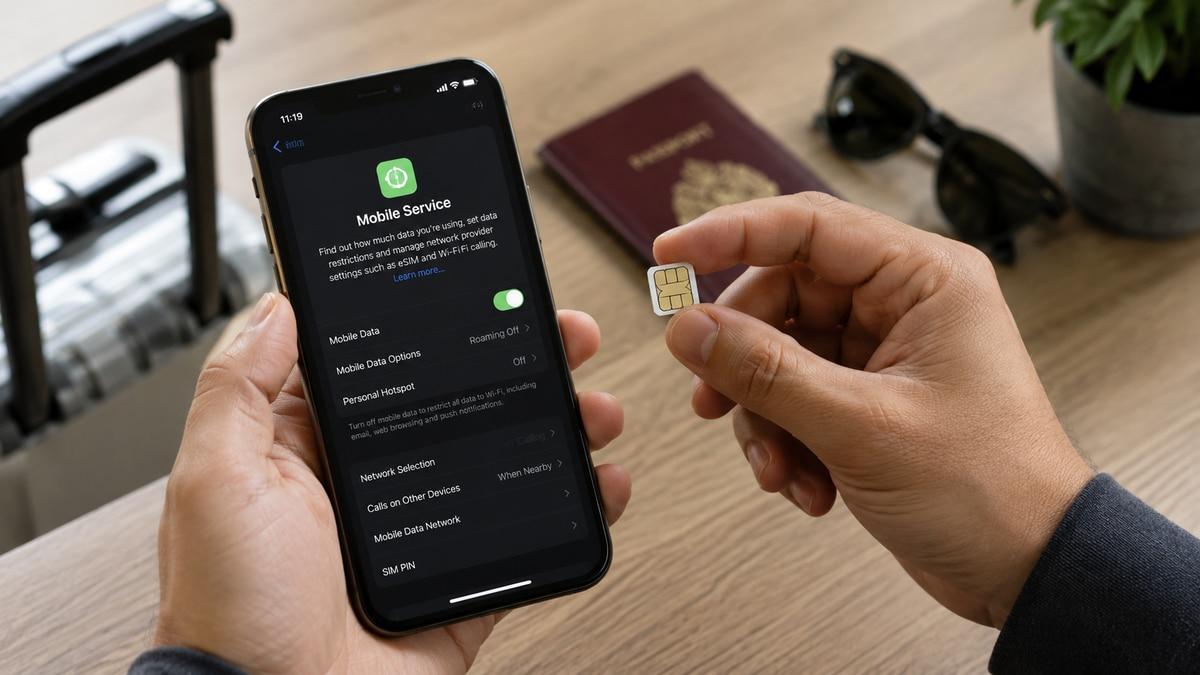
An eSIM is the exact same thing in software form. It lives inside a chip soldered to your phone’s motherboard. Instead of swapping a card, you download a carrier profile through an app or a QR code. The technology is identical underneath. The user experience is what really differs.
Both connect to the same towers. Both deliver the same call quality. Both pull data from the same networks. The differences appear elsewhere. That is exactly where international travelers feel the impact.
Set up speed, the most obvious gap
On a quiet Tuesday at home, the difference between five minutes and ten minutes is nothing. After a transatlantic flight, that gap suddenly feels like a chasm.
With a physical travel SIM, the routine usually looks like this. Find a vendor at the airport or in town. Wait in line. Show your passport. Pay in local currency or hope your card works. Swap your home SIM with the new one. Store the original card somewhere safe. Hope the activation goes through within a few minutes.
With an eSIM, the flow is shorter. Download the provider’s app a day or two before you leave. Buy your plan over WiFi at home. Install the profile. When you land, you flip a switch in your phone settings, and you are online before you reach the taxi rank. Total active time, around two minutes.
For frequent flyers, this is the single biggest reason eSIM has gone mainstream.
Cost, where the truth is more layered
eSIM evangelists love to claim that eSIMs are always cheaper. That is half true.
For short and medium trips, eSIM almost always wins. International roaming on most US carriers runs around ten dollars a day. That figure climbs fast over a two-week vacation. A regional eSIM plan covering Europe, Asia, or Latin America usually costs between fifteen and forty dollars for the same period. Several gigabytes are usually included.
For very long stays in a single country, a local physical SIM still wins on raw price. Walk into a phone shop in Bangkok or Lisbon, and you can find prepaid SIMs starting at two or three dollars. No eSIM provider can match that floor.
The smart middle ground is this. Short multi-country trip, eSIM. Three months in one country, local physical SIM. Anything in between, run the numbers and check whether convenience is worth the small premium.
Coverage and network quality
Here is a myth worth busting. eSIM does not give you a better or worse signal than a physical SIM. They both connect to the same antennas. Speed depends on the carrier behind the plan, not the format of the SIM.
That said, eSIM providers often partner with multiple local networks at once, which means your phone can hop between operators inside the same country. Useful in the countryside, in train tunnels, or in cross-border regions where one carrier fades and another picks up.
Physical local SIMs sometimes get priority on the home network. That can show up in benchmark tests. In real-world use, you would barely notice.
Multi-country trips, the strongest eSIM use case
If your itinerary spans more than two countries, the eSIM advantage becomes overwhelming. Picture a classic European loop. Paris, Amsterdam, Berlin, Vienna, Rome. With physical SIMs, that means five separate visits to phone shops. Five different SIM cards are floating around in your wallet. Five activation routines in five different languages.
Regional plans make this disappear. A single profile covers everything from Lisbon to Helsinki without changing a thing when you cross a border. For Europe specifically, you can choose the best eSIM for Europe by comparing plans that work across all forty-plus European countries on one activation. One app, one bill, one connection across the entire continent.
That is the kind of friction removal that turns a stressful logistics problem into a non-issue.
Dual-SIM, the quiet superpower
Most modern smartphones now run a physical SIM and an eSIM at the same time. That changes the conversation entirely.
You keep your home number active on the physical line. Calls and texts from family. Banks and two-factor codes, too. Everything keeps coming as usual. On the eSIM, you load a travel plan for cheap data abroad. Your phone uses the travel eSIM for everything that costs money, and your home SIM for everything that needs your real identity.
This setup did not really exist three years ago. In 2026, it is the default workflow for a huge share of international travelers. It also kills the old fear of disappearing off the grid the moment you swap a card.
Security, a small but real win for eSIM
A physical SIM can be popped out of a stolen phone and dropped into another device. That matters because SMS-based two-factor authentication still runs the banking world. A stolen SIM in the wrong hands is a real problem.
An eSIM cannot be physically removed. To extract it, someone would need to unlock your phone and dig through menus. That is a meaningful extra layer.
It does not replace a strong passcode or app-based two-factor authentication. But on the security ledger, eSIM has a clear edge.
Where physical SIM still beats eSIM
Let’s be fair. The plastic chip is not going anywhere yet. There are good reasons for that.
Older phones and budget devices
If your phone is more than five or six years old or if it is a budget model sold in certain regions, eSIM support may simply not exist. No app or update can add the hardware after the fact.
Phone-to-phone transfers
Drop your physical SIM into a new device, and you are online in ten seconds. Transferring an eSIM between phones still depends on your carrier. The process can range from smooth to genuinely painful. Apple and Samsung have improved things. The experience is still not uniform across the board.
Long stays in a single country
If you are going to spend six months in Vietnam, a local prepaid SIM at three dollars a month is hard to beat. eSIM premium pricing makes more sense for short visits than for extended ones.
Regions with patchy eSIM support
Some carriers in developing regions still do not offer eSIM. If you are heading off the beaten path, a physical SIM may be the only option once you arrive.
How to pick the right option for your next trip
Skip the long checklist. Three quick questions usually settle the matter.
First, does your phone support eSIM? Open your settings and look for the menu. If yes, you have the option. If not, the choice is made for you.
Second, how long are you traveling, and how many countries are on the route? Short and multi-country, lean eSIM. Long and single-country, lean physical SIM.
Third, do you need a local phone number for restaurants, deliveries, or local services? Some travel eSIMs include a real local number; others are data-only. Read the fine print before you buy.
Once you answer those three, the rest is just picking a provider that matches your destination, your data needs, and your budget.
The honest verdict for 2026
For the average international traveler in 2026, eSIM wins more often than not. It saves time at airports. It removes the SIM-hunting routine. It plays nicely with dual-SIM phones. It costs less than roaming for almost any trip under a month. And it turns multi-country travel into a seamless experience rather than a logistics puzzle.
Physical SIM still has its corner of the ring. Older phones, long stays, ultra-budget travel, and a few off-grid destinations where eSIM has not caught up. The technology is not dead. It is just no longer the default.
If you are buying your next plane ticket today, the smartest move is usually simple. Check your phone. Pick a reputable eSIM provider that covers your destinations. Keep your home SIM tucked safely in the same tray it always lived in. That hybrid setup is, for most people, the best of both worlds.