
Electrolysis is an electrochemical process that uses electrical energy to drive a chemical reaction. During water electrolysis, electricity helps separate water molecules into hydrogen gas and oxygen gas.
This process takes place inside a device called an electrolyzer. In hydrogen water generators and some portable hydrogen water bottles, the hydrogen produced during electrolysis is directed toward the drinking water, where part of it dissolves as molecular hydrogen.
Key Takeaways
- Electrolysis uses electricity to separate water into hydrogen and oxygen.
- Hydrogen forms at the cathode, while oxygen forms at the anode.
- The two electrode processes are called the hydrogen evolution reaction (HER) and oxygen evolution reaction (OER).
- Many hydrogen water bottles use an SPE or PEM membrane system to help separate hydrogen from oxygen.
- Electrolysis produces hydrogen gas, but the amount that remains dissolved depends on the device, water conditions, pressure, sealing, and generation cycle.
How Does Water Electrolysis Work?
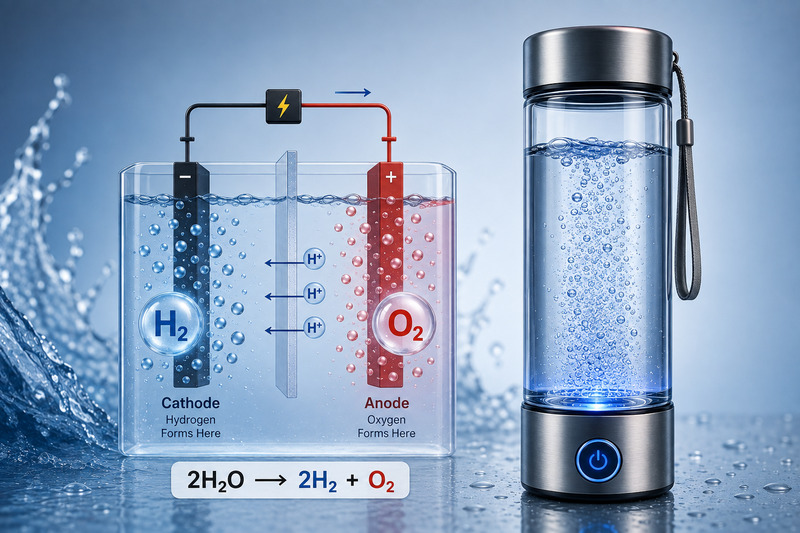
A water-electrolysis system contains two electrodes connected to a source of direct electrical current:
- Cathode: The negatively charged electrode where hydrogen is produced
- Anode: The positively charged electrode where oxygen is produced
An electrolyte or ion-conducting membrane allows charged particles to move between the electrodes while electrons move through the external electrical circuit.
The overall water-splitting reaction is:
2H₂O → 2H₂ + O₂
This means that two water molecules can be converted into two molecules of hydrogen gas and one molecule of oxygen gas.
Bu US Department of Energy describes electrolysis as the use of electricity to split water into hydrogen and oxygen inside an electrolyzer. Electrolysis itself does not determine whether the resulting hydrogen is low-carbon; that depends largely on the electricity source used to power the process.
Two Electrode Reactions Happen at the Same Time
Water electrolysis consists of two linked reactions:
- Hydrogen evolution reaction, or HER: Hydrogen forms at the cathode.
- Oxygen evolution reaction, or OER: Oxygen forms at the anode.
The exact half-reaction equations depend on the electrolyte and membrane system.
PEM Electrolysis Reactions
In a proton exchange membrane system, the reactions can be written as:
Anode:
2H₂O → O₂ + 4H⁺ + 4e⁻
Water forms oxygen, hydrogen ions and electrons at the anode.
Cathode:
4H⁺ + 4e⁻ → 2H₂
The hydrogen ions cross the membrane and combine with electrons at the cathode to form molecular hydrogen.
Alkaline Electrolysis Reactions
In an alkaline system, hydroxide ions are involved instead:
Cathode:
2H₂O + 2e⁻ → H₂ + 2OH⁻
Anode:
4OH⁻ → O₂ + 2H₂O + 4e⁻
Both PEM and alkaline systems produce the same overall result—hydrogen and oxygen—but they transport different ions through the electrolyte.
What Are SPE and PEM Electrolysis?
SPE means solid polymer electrolyte. PEM commonly means proton exchange membrane or polymer electrolyte membrane.
The terms are frequently used together in descriptions of hydrogen water generators. In a PEM electrolysis system, the membrane conducts hydrogen ions while helping keep the hydrogen and oxygen sides of the electrolysis cell separated.
Many portable hydrogen water bottles advertise SPE/PEM technology. Depending on the bottle’s design, hydrogen produced at the cathode is introduced into or generated beside the drinking-water chamber. Oxygen is directed toward a separate chamber or outlet.
The membrane does not automatically guarantee that all generated hydrogen will remain in the water. Some hydrogen dissolves, while some may remain as bubbles or escape into the headspace.
How Does the Hydrogen Dissolve in Water?
Hydrogen initially forms as very small gas bubbles on or near the cathode surface. Some of this gas dissolves into the surrounding water.
Research examining an SPE water electrolyzer found that hydrogen dissolution begins around small bubbles adhering to and leaving the electrode surface. The proportion that dissolves depends on the design and operating conditions.
Molecular hydrogen has limited solubility in water. Its equilibrium concentration is affected by factors including:
- Gas pressure
- Water temperature
- Generation rate
- Water volume
- Electrode surface area
- Headspace volume
- Container sealing
- Time between generation and testing or drinking
Hydrogen solubility follows gas–liquid equilibrium principles such as Henry’s law, meaning pressure and temperature influence how much hydrogen can remain dissolved.
Does Electrolysis Change Water Into a Different Substance?
The bulk drinking water remains H₂O. Electrolysis consumes a very small portion of the water to create hydrogen and oxygen gases.
When hydrogen dissolves in the remaining water, it exists mainly as molecular hydrogen, H₂. It does not turn every water molecule into a new type of “hydrogenated” water molecule.
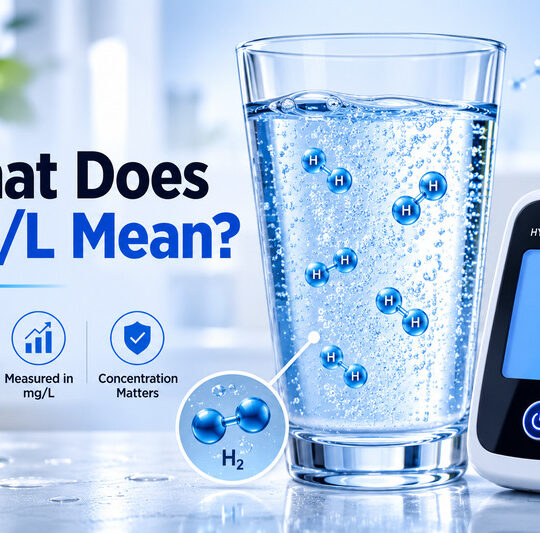
Hydrogen concentration should therefore be measured directly in units such as mg/L, PPM or micromoles per liter rather than inferred only from bubbles, pH or oxidation-reduction potential.
Related Terms
Sources and Further Reading
- Catarina Mansilha, Ana Barbosa-Póvoa, Luís Tarelho, André Fonseca; …green hydrogen production technologies… Renewable and Sustainable Energy Reviews. 2025. https://www.sciencedirect.com/science/article/pii/S1364032125007920
- Haitham Al Dhahri et al.; Green hydrogen production via electrolysis… Renewable and Sustainable Energy Reviews. 2025. https://www.sciencedirect.com/science/article/abs/pii/S1364032125012900
- Mohammad Abubakr, Suhaib Shahid, Iram Arman; …Hydrogen Production Technologies… arXiv. October 2024. https://doi.org/10.48550/arXiv.2410.08154