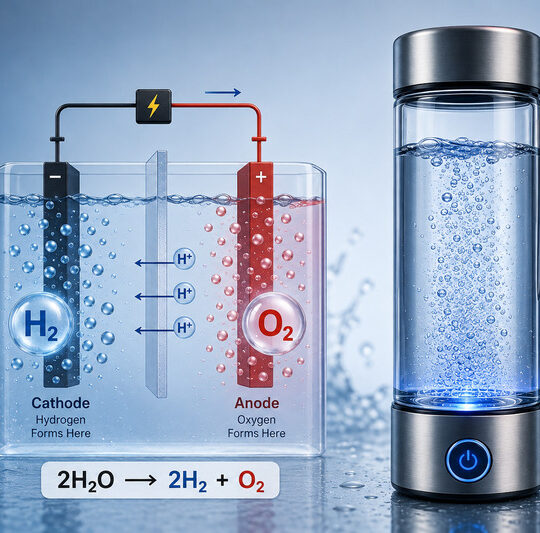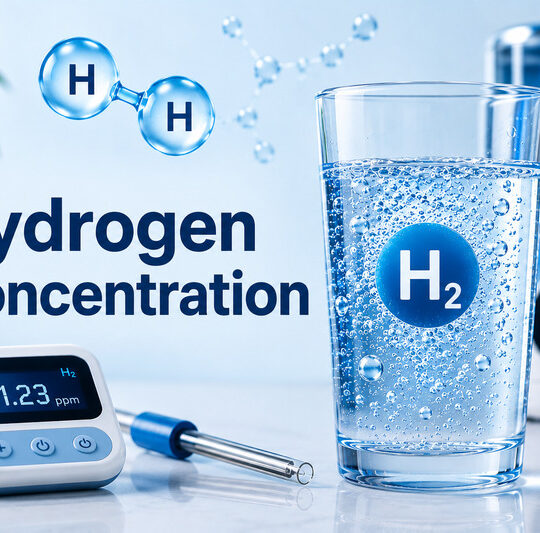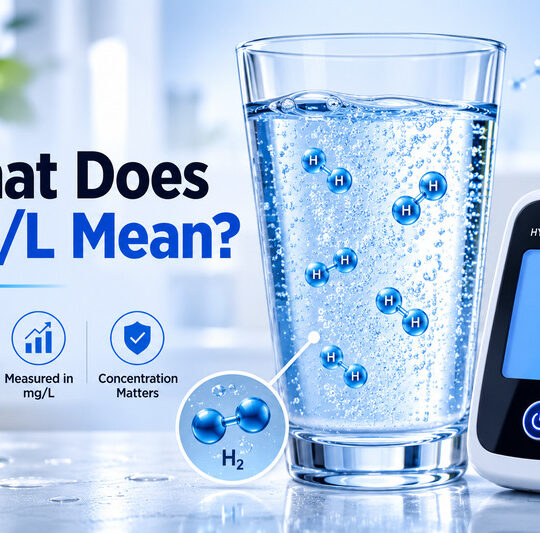
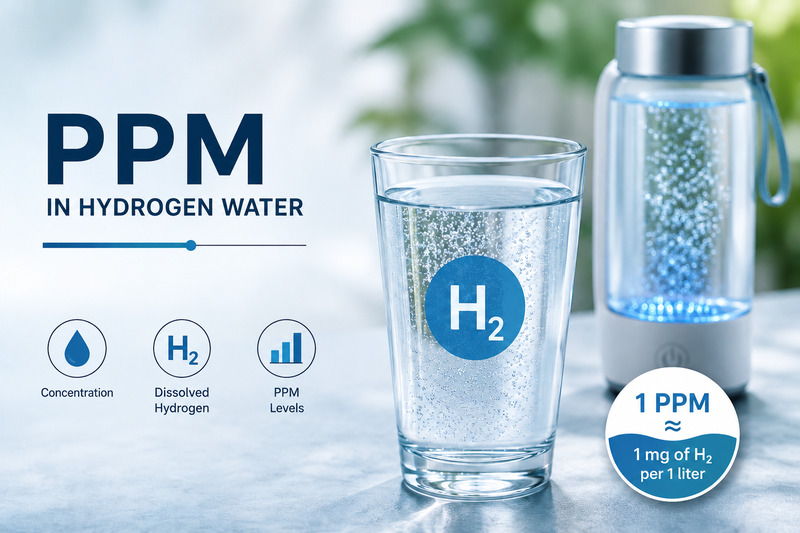

PPM, or parts per million, is the standard unit used to measure the concentration of dissolved molecular hydrogen (H₂) in hydrogen-rich water. It indicates how much hydrogen gas is present in the water at the time of testing.
For hydrogen-rich water, a concentration of 1 PPM is roughly equivalent to 1 milligram of dissolved molecular hydrogen per liter of water (1 mg/L). A higher PPM reading means that a greater amount of dissolved hydrogen was present in the water at the time of testing.
Key Takeaways
- PPM stands for Parts Per Million.
- It measures the concentration of dissolved molecular hydrogen (H₂) in water.
- In hydrogen water, 1 PPM ≈ 1 mg/L.
- Higher PPM indicates more dissolved hydrogen, not necessarily greater health effects.
- PPM values can decrease over time as hydrogen gas escapes from the water.
Why Is PPM Important?
Hydrogen water products are often compared based on their hydrogen concentration. Since molecular hydrogen is considered the active component being studied, manufacturers commonly report the PPM value to show how much dissolved hydrogen their device or product produces.
However, PPM only measures concentration. It does not prove that one product is more effective or healthier than another.
Other factors also influence product quality, including:
- Hydrogen generation technology
- Water volume
- Generation time
- Testing method
- Packaging quality
- Storage conditions
How Is PPM Measured?
Several testing methods are used to determine dissolved hydrogen concentration.
Common methods include:
- Dissolved hydrogen meters
- Reagent drop test kits
- Portable hydrogen analyzers
- Laboratory gas chromatography
Different testing techniques may produce slightly different results because hydrogen is highly volatile and can escape quickly during sampling. For this reason, trustworthy manufacturers should explain how and when the measurement was performed.
Is Higher PPM Always Better?
Not necessarily.
A higher PPM simply means that more molecular hydrogen was dissolved in the water when it was tested. Current scientific research has not established an ideal hydrogen concentration for health benefits, nor has it shown that increasing PPM always produces better outcomes.
Hydrogen water research is still evolving, and existing studies have used a wide range of hydrogen concentrations.
Consumers should be cautious of products making claims such as:
- “Highest PPM means maximum health benefits.”
- “More hydrogen guarantees better results.”
- “Higher PPM cures disease.”
These claims are not supported by current clinical evidence.
Why Does PPM Decrease Over Time?
Molecular hydrogen is the smallest gas molecule and easily escapes from water. As hydrogen leaves the water, the PPM value gradually drops.
Hydrogen concentration decreases faster when water is:
- Left uncovered
- Stored for long periods
- Frequently opened
- Shaken repeatedly
- Exposed to warm temperatures
- Kept in packaging that allows hydrogen to diffuse out
For this reason, hydrogen-rich water is generally consumed soon after it is generated or opened.
PPM vs. PPB
PPM (parts per million) and PPB (parts per billion) are units used to describe the concentration of a substance dissolved in water. The difference is simply the measurement scale.
PPM (Parts per million)
- 1 ppm ≈ 1 mg/L in water
- Larger concentration unit
- Commonly used for dissolved hydrogen concentration in consumer hydrogen water products
PPB (Parts per billion)
- 1 ppb ≈ 1 µg/L in water
- Smaller concentration unit
- Commonly used for trace contaminants and environmental water testing
Conversion: 1 ppm = 1,000 ppb
Most hydrogen water bottles and generators report dissolved hydrogen levels in PPM because the concentrations produced are typically within the parts-per-million range.
PPB is more commonly used when measuring extremely low concentrations, such as contaminants or trace chemicals.
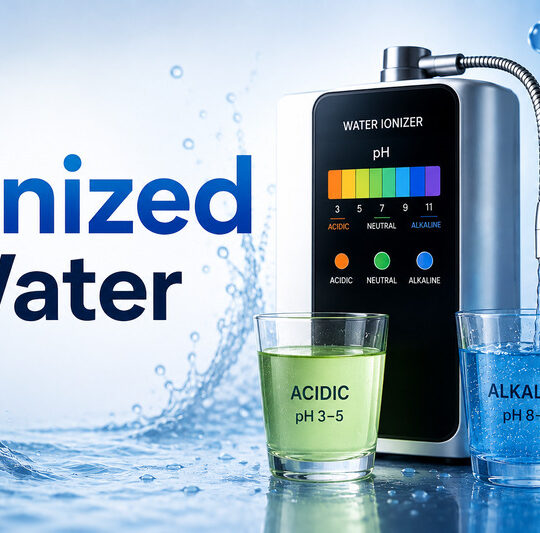
PPM vs. pH
PPM and pH are often confused, but they measure completely different things.
| PPM | pH |
|---|---|
| Measures dissolved molecular hydrogen | Measures acidity or alkalinity |
| Expressed as parts per million (PPM) | Expressed on the pH scale (0–14) |
| Indicates hydrogen gas concentration | Indicates hydrogen ion (H⁺) concentration |
| Does not determine whether water is acidic or alkaline | Does not measure dissolved molecular hydrogen |
What PPM Levels Do Hydrogen Water Products Usually Have?
Different hydrogen water products produce different concentrations.
Typical ranges include:
- 0.3–0.8 PPM: Lower hydrogen concentration
- 0.8–1.5 PPM: Common range for many portable generators
- 1.5–3.0 PPM: Higher concentrations reported by some premium devices
Actual performance depends on the product, water quality, testing conditions, and generation time.
Related Terms
Sources and Further Reading
LeBaron, T. W., Sharpe, R., & Ohno, K. (2022). Electrolyzed–Reduced Water… International Journal of Molecular Sciences, 23(23), 14750. https://doi.org/10.3390/ijms232314750
Johnsen, H. M., Hiorth, M., & Klaveness, J. (2023). Molecular Hydrogen Therapy… Molecules, 28(23), 7785. https://doi.org/10.3390/molecules28237785
NCBI (2026). PubChem Compound Summary for CID 783, Hydrogen. Retrieved July 24, 2026, from https://pubchem.ncbi.nlm.nih.gov/compound/Hydrogen.